Blockchain basic applications I: crypto currency
In the introduction of blockchain we established that this technology is attractive for decentralized applications, in which trust (or rather distrust of each other) plays a crucial role. Decentralized recording of money flows - i.e. without the intervention of a bank - is a good first option, because no one trusts each other blindly.

If we look at how a normal bank normally handles this, we see the principle of the general ledger. Transactions - deposits, payments, withdrawals and receipts - are all recorded centrally in a ledger and kept there. The bank thus has an overview of all money flows and guarantees that your balance based on the ledger really belongs to you. This is a safe and orderly thought for yourself and for others.
Trust
But how can you rely on that to happen without such a bank? After all, if no one centrally holds your property (or debt), can you trust that someone else (a peer) will have real money to pay you right away or that someone else will actually deliver something after you pay them?
The answer to this consists of several steps :
- The creation of a blockchain in which all transactions are recorded in blocks, digitally signed, so that they cannot be changed just like that afterwards .
So, a hash-based ledger that contains the complete history of all transactions, which we know to be correct and with which we can verify whether someone who wants to make a subsequent transaction (still) has the means to do so. - The creation of a large number of copies (nodes in a peer-to-peer network) of such a blockchain (ledger) for an unlimited number of anonymous users (the peers). In it, all the nodes know the same, complete transaction history (size, time, nodes).
So a distributed ledger. - The creation of digital encryption keys (private keys and public keys), used for decentralized approval and handling of transactions (i.e., payments and receipts) between nodes.
Elimination of the need for controlling intermediaries, who centrally manage or control the transaction records: banks, governments, accountants, notaries.
About keys
More information about keys
A private key is an individual string of bits (similar to a hash) that is not known to the other nodes in the blockchain because it belongs to the person who is authorized to make payments as a person (to the extent that the transaction history, or balance, of that person's node allows).
The combination of a concrete payment and a private key together form the signature that this person puts as proof that he is the one who may and wants to make the payment. And as we saw earlier with hashes, even such a signature cannot be traced back to the private key itself.
A public key is a string of bits that is known in the blockchain and with which it can be verified whether the actual payment plus the signature really belongs to the used private key (which was in fact once created together with this public key).
It is literally determined whether it is true or false that the payer who makes this payment and issues this signature had to know the correct private key in order to be able to produce this payment and signature without an enormous amount of trial and error.
NOTE For the latter method of determination, it is no longer necessary to reveal the private key itself. After all, that one remains private.
If the signature is approved, it can be placed in the latest/last block to become part of the transaction history in this blockchain and will also show whether - based on that history - the transaction can proceed as such.
Miners
And with that, the next urgent challenge starts: how do we create a new block in a chain that satisfies all nodes? After all, the power of a distributed ledger is that all participants know the same transaction history and approve new blocks together.
For this purpose, we introduce the concept of miners. These are nodes that can add new blocks to the chain (mining). Two aspects are important for this:
Aspect 1: The mathematical algorithm underlying the specific blockchain.
Aspect 2: The requirement for hashes in that particular blockchain.
The first aspect is related to the type of digital currency (also called crypto currency) used in a blockchain. The oldest and best known type is bitcoin. In fact, this currency is nothing more than a complete economic transaction history, recorded in a blockchain that uses the unit of account bitcoin in transactions and where blocks are created with an algorithm that belongs to the creation of the currency bitcoin.
Note: anyone who has devised a new algorithm to create blocks in a certain, new way (mining) and defines a fixed, new unit of account for all transactions in these blocks, is thereby creating a new crypto currency themselves. Just like bitcoin is.
The second aspect is also related to the coin type, but concerns a specific requirement placed on the hashes in the chain. For example, in the simplified table from the previous introduction, we saw that each new block hash started with four zeros.
Simplified example chain of blocks in Blockchain
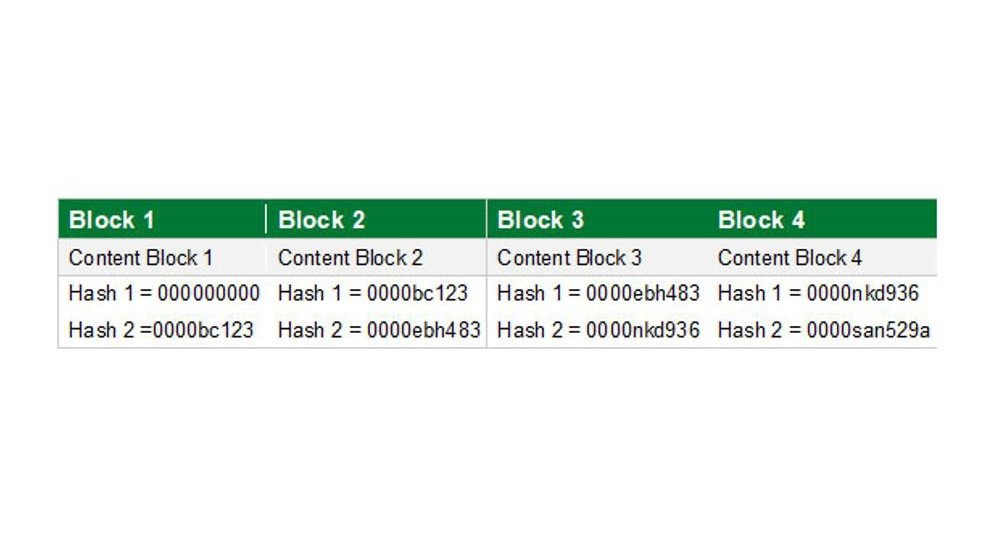
Now what a miner in this example is doing (with a small amount of currency as a reward) is checking how the algorithm of the specific crypto currency and the exact content of a block produces an outcome that starts with the required four zeros.
Nonce
Mining is like laying out a trial-and-error puzzle. That is, very often placing another number in the algorithm, until the concrete contents of the records and the hash of the previous block produce an acceptable new hash (four zeros) from that algorithm. This one number is called a nonce and thus belongs both to the content of the block and to (the algorithm of) the specific crypto currency. Only in that algorithm and with that content does the nonce in question produce a hash with four zeros
In a large blockchain, new blocks are thus offered by miners, who earn their money with them. The miner who first finds the next nonce and whose proof of work (or proof of stake) is accepted by the other nodes, may add the new hash and with it the new block to the chain, after which it can be copied by all other nodes and added to their copy of the chain. Then the transactions in that block can be checked and executed (credible) or skipped (overspent).
Crypto currency is therefore a particularly clever and by now very popular use of blockchain. You can read that much more is possible with blockchain in my next blog.
Related articles
-

What is blockchain?
Blockchain is still sometimes referred to in the media as "the greatest innovation since the Internet. But what exactly is blockchain?
-

The blockchain: where is Europe?
China and the United States are leaders when it comes to blockchain technology. For example, the Chinese megacity of Chongqing - with some 31 million inhabitants - recently launched its own innovation competition around Blockchain of Things, a combination of blockchain technology and Internet of Things. And Europe? It's following closely, surely? Not exactly.
-

Blockchain for transparency government
In 2020, the accountancy and consultancy organization BDO published a research report (performed by Publicum) with data on the state of affairs worldwide regarding the blockchain in the public sector. This report provides a good insight into how this topic is at the top of the agenda, but is not yet really taking off. Half of the organizations surveyed have taken steps, but only 6% actually invest money in projects. It is therefore remarkable that, in response to this publication, BDO Netherlands reports that, according to the VNG (Association of Dutch Municipalities), 100 municipalities are conducting pilots with blockchain.