What is blockchain?
Blockchain is still sometimes referred to in the media as "the greatest innovation since the Internet. But what exactly is blockchain?
To answer this question, we must first divide the term into two parts: block and chain. The latter part is the simplest in this context: a chain is a chain of links. So a block chain is a chain of blocks. But what is a block? To understand that, it is useful to know first what a database is, so we park the explanation of block after the explanation of database.
Database
A database is a collection of data, set up for flexible searching and use. This setup is characterized by the use of so-called records and columns. For convenience, compare these with rows and columns in Excel (not a database, but a calculation program).
Now imagine a horizontal row of several contiguous cells, in which you can record something per cell. For example, if such a record describes me as a person, then the first cell contains my name, the second cell (next to it) my age, the third cell next to it my BSN, and so on. If you describe several people in this way, you create columns as well as records. The first column then contains all the names, the second the ages and the third the BSN numbers.
A group of multiple, similar records and columns under one another is called a dataset, database or data file. Anything can be described in it: persons (as in the example), objects, but also transactions or process data.
Block
What about a block? A block is also such a dataset, database or datafile, but with some special additional features, including a hash. A hash is the result of a mathematical function that converts the actual content(!) of all records in a dataset, database or datafile into one continuous code - the hash - with a fixed number of characters, letters and/or numbers.
This could be a hash, for example: 5a3243e20e2c6c58e885a65393e85c64f2e34223c813f9f954246d8ec244c54d
About hashes
More information about a hash
If you like math, the nice thing about such a hash is that it only works in one direction: you can use this mathematical function to calculate a hash of any combination of content, which is always the same for the same content, but you can never find out which content it was if you only know that hash.
The hash now reflects the entire contents of all the records in a block. Now if I change even one piece of content from one cell in one of those records, the hash will also change. That is why it is easy to determine via the hash of a block whether its contents have changed over time. This makes blocks naturally suitable for datasets, databases or data files that we would rather keep intact and unchanged forever.
You can also encrypt content that you want to save and protect for extra security. This works both ways, by the way. Whoever has the right key can also read the data back. Hashes are there to make sure that no one changes the data easily and encryption is used to make data only accessible to those who have the key.
Chain of blocks
So a blockchain is a chain of multiple blocks. If we connect these blocks (each with its own hash), it is done via these hashes. This works as follows.
The first block has one own hash. The second block linked to it has two hashes: the first is a copy of the hash from the first block and the second is the second block's own hash. For the third block in the chain, it works the same way: the first hash of the third block is a copy of the second block's own hash and the second is the third block's own hash.
Confused? Here is a greatly simplified example:
Simplified example chain of blocks in Blockchain
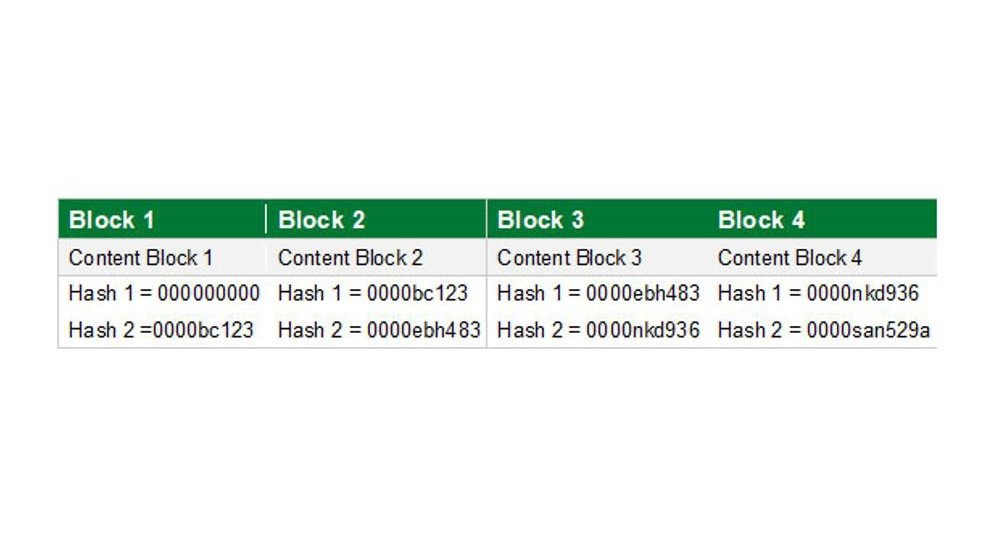
And this is what a blockchain actually looks like: a chain of blocks, connected to each other by hashes, where the old hash of the previous one belongs to the content of the next one.
So if I were to change something in one of the blocks, then all the hashes that follow would also change and this inconsistency would become visible across the entire chain after the changed block. In this way, a blockchain forms a more or less composite dataset, database or datafile, of a non-mutable kind (also called a ledger). Non-mutable, because changes are preferably only made if this involves the addition of a new block and not changes to what was already there.
Distrust
In doing so, as crazy as this sounds, a blockchain remains most secure or consistent when stakeholders with opposing interests use it. In other words, distrust in each other inherently causes one to have the utmost confidence that the content in the chained blocks is correct and will continue to be correct. This is also what makes blockchain so attractive for applications in which trust (or rather distrust) plays a crucial role: crypto currency with a certain value, contracts with certain characteristics, transactions with a certain content, or binding units such as votes in a referendum.
Related articles
-
The blockchain: where is Europe?
China and the United States are leaders when it comes to blockchain technology. For example, the Chinese megacity of Chongqing - with some 31 million inhabitants - recently launched its own innovation competition around Blockchain of Things, a combination of blockchain technology and Internet of Things. And Europe? It's following closely, surely? Not exactly.
-
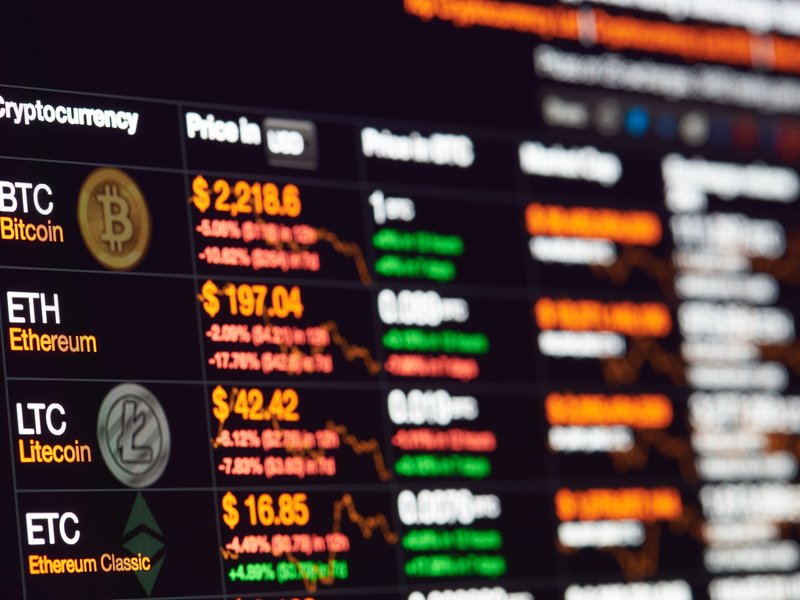
Blockchain basic applications I: crypto currency
Blockchain is attractive for decentralized applications, in which trust (or rather distrust of each other) plays a crucial role. Decentralized recording of money flows - i.e. without the intervention of a bank - is a good first option, because no one trusts each other blindly.
-

Blockchain for transparency government
In 2020, the accountancy and consultancy organization BDO published a research report (performed by Publicum) with data on the state of affairs worldwide regarding the blockchain in the public sector. This report provides a good insight into how this topic is at the top of the agenda, but is not yet really taking off. Half of the organizations surveyed have taken steps, but only 6% actually invest money in projects. It is therefore remarkable that, in response to this publication, BDO Netherlands reports that, according to the VNG (Association of Dutch Municipalities), 100 municipalities are conducting pilots with blockchain.